When you embark on a creative project featuring the beloved characters and vibrant world of Disney Jr., understanding the official logo downloads and usage guidelines isn't just a formality—it's the bedrock of respecting the brand's integrity and safeguarding its magic. As creators, producers, marketers, or even educators looking to leverage the power of Disney Jr., navigating these directives ensures your work aligns seamlessly with the values and visual identity that millions of children and families cherish.
Ignoring these guidelines isn't just bad practice; it can lead to legal complications and dilute the very essence of what makes Disney Jr. special. This comprehensive guide will equip you with the knowledge to correctly identify, acquire, and deploy the official Disney Jr. logo, allowing your creations to shine while upholding the high standards of The Walt Disney Company.
At a Glance: Key Takeaways for Disney Jr. Logo Use
- Always Seek Official Assets: Obtain logos directly from authorized Disney channels (e.g., partner portals, media kits), never from unofficial sources.
- Adherence is Non-Negotiable: Strict compliance with Disney’s brand guidelines is mandatory for any approved usage.
- No Unauthorized Alterations: Do not stretch, distort, recolor, add effects, or modify the logo in any way.
- Licensing is Paramount: Commercial use, including merchandise, apps, or public-facing digital content, almost always requires an explicit licensing agreement.
- Stay Current: The Disney Jr. logo has evolved; ensure you are using the most recent official version provided for your specific project.
- Respect Intellectual Property: Understand copyright and trademark requirements, including proper attribution.
The Enduring Magic: Why Disney Jr.'s Brand Identity Matters
Disney Jr. isn't just a channel; it's a foundational experience for children aged two to seven, a place "Where the magic begins." Owned by The Walt Disney Company, it delivers a carefully curated blend of entertainment and education, fostering positive values, social skills, and critical thinking through engaging stories and beloved characters. Think of shows like Doc McStuffins promoting empathy and health, or Mickey Mouse Clubhouse encouraging problem-solving.
This profound trust and recognition aren't accidental. They're built on decades of consistent quality and a meticulously managed brand identity. The Disney Jr. logo, in particular, is the visual shorthand for this promise—a bright, welcoming symbol that immediately connects audiences to a world of wonder and learning. For any creator, respecting and accurately portraying this logo is crucial to tapping into, rather than detracting from, that established equity.
A Journey Through Time: Understanding the Disney Jr. Logo Evolution
To correctly use the Disney Jr. logo today, it helps to understand its lineage. Brand identities, especially for such prominent properties, are dynamic, reflecting changing aesthetics, technological capabilities, and strategic shifts.
From Playhouse Disney to Disney Junior: The Genesis
The brand's roots trace back to the "Disney Channel Preschool Block" in 1997, which blossomed into "Playhouse Disney" in 1999. This era featured iconic shows and a distinctive logo that evolved over time:
- 1999-2001 Playhouse Disney Logo: An early design, it incorporated a TV screen, classic Disney characters like Winnie-the-Pooh, and a multi-colored "playhouse" alongside the corporate "Disney" font. It was playful but hinted at the brand's youthful focus.
- 2002-2011 Playhouse Disney Logo (Primary): This version became synonymous with the Playhouse Disney era. It famously showcased a yellow Mickey Mouse head, often peeking in from the corner, encompassing the colorful, 3D "playhouse" inscription. A subtle refinement in 2010-2011 fully integrated Mickey's left ear into a yellow rectangular base, a testament to Disney's attention to detail.
The rebrand to Disney Junior was announced in May 2010, signaling a fresh chapter. The programming block officially launched on Disney Channel in February 2011, replacing Playhouse Disney, and the standalone Disney Junior channel debuted in the U.S. in March 2012, replacing SOAPnet. This transition brought with it a completely new visual identity.
The Iconic 2011-2024 Logo: Mickey's "I"
For thirteen years, this logo defined Disney Junior. It was an instant classic, recognizable for its clever integration of Disney's most famous character:
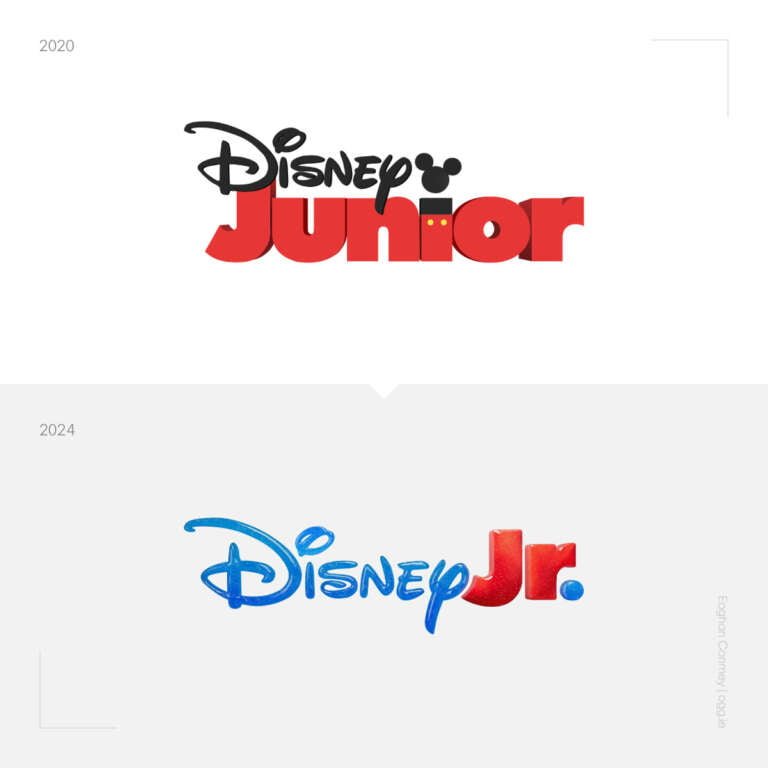
- Design Elements: The logo featured "Disney" rendered in Walt Disney's iconic signature handwriting, retaining a link to the overarching Disney brand. "Junior" was presented in a large, red, chunky Futura Extra Bold font with irregular, playful, 3D contours.
- The Mickey Mouse "I": The most striking element was the letter "I" in "Junior," which was stylized as Mickey Mouse himself. His black silhouette head formed the dot of the "I," and his body (black top, red bottom with yellow buttons) composed the vertical bar. This ingenious design made the logo instantly endearing and unmistakably Disney.
- 22020 Update: While the core design remained, a subtle update in 2020 introduced a gradient to Mickey Mouse's head and more pronounced shade transitions on the "Junior" letters. Gray shadows were added underneath, enhancing the 3D effect and giving it a slightly more modern pop.
This logo presided over the launch of many fan-favorite original shows, including Jake and the Never Land Pirates, Doc McStuffins, and Sofia the First.
The New Era: The 2024-Present "Disney Jr." Logo
On June 1, 2024, Disney Junior unveiled its latest evolution, embracing a cleaner, yet equally playful, aesthetic. This is the logo you should prioritize for any current projects:
- Modern Simplicity: The new logo is stylized as "Disney Jr." (similar to Nick Jr.), indicating a slight shift in naming convention as well.
- Visual Characteristics: "Disney" remains in Walt Disney's signature style but is now rendered in a rich blue with a subtle, sparkling texture, evoking a sense of wonder. "Jr." is in a contrasting, vibrant red, featuring a smooth, rounded font with a sophisticated three-dimensional effect. A small, cheerful blue dot follows "Jr.", adding a touch of personality and tying back to the "Disney" blue.
- Alternate "DJr." for Social Media: Recognizing the need for concise branding in digital spaces, an alternate version, "DJr.", was introduced, primarily for social media pages, first seen with promotional material for Ariel.
Crucial Takeaway: For most new initiatives, the 2024-Present "Disney Jr." logo is the official standard. Ensure you are always using the most up-to-date version provided by Disney.
Show-Specific Logo Variants: A Creative Twist
One of the most charming aspects of the Disney Junior brand identity is its flexibility for individual shows. While the "Disney" part of the logo consistently maintains Walt Disney's signature handwriting, the "Junior" letters often transform to reflect the unique theme or characters of a particular series.
- Examples of Customization:
- Standard 2011-2024 Logo: The "I" is Mickey Mouse.
- Captain Jake and the Never Land Pirates: The "J" might represent Captain Hook, the "I" Captain Jake, and the "R" a cannon, immersing the logo in the show's adventurous spirit.
- Doc McStuffins: The "I" could be Doc McStuffins herself, symbolizing her caring nature.
- Sofia the First: Similarly, Sofia might appear as the "I," embodying her royal journey.
- Mickey and the Roadster Racers: A vibrant example where the "J" could be Minnie Mouse, the "I" Mickey in his racing gear, and the "O" Donald Duck, each element reflecting the high-octane fun of the show.
- Other variants utilize patterns like Minnie Mouse's dress, glitter, playground equipment, undersea motifs, or balloons to playfully form the "JUNIOR" text, adding a bespoke feel to each series' branding.
These show-specific variants are integral to the sub-brands within Disney Jr. If your project focuses on a particular show, you'll need to secure the specific variant approved for that series, in addition to the overall Disney Jr. logo.
The Golden Rulebook: Navigating Official Disney Jr. Logo Usage Guidelines
Using the Disney Jr. logo isn't merely about having the right image file; it's about adhering to a comprehensive set of rules designed to protect Disney's intellectual property and maintain brand consistency globally. This isn't just bureaucratic red tape; it's the framework that upholds the quality and integrity millions associate with the Disney name.
Section 1: The Non-Negotiables – Core Principles of Brand Integrity
Before any design work begins, internalize these foundational principles. They dictate the very possibility and scope of your logo usage.
- Authorization is Key: This is arguably the most critical point. Official usage of the Disney Jr. logo, especially for commercial purposes (merchandise, apps, public advertisements, digital games), requires explicit authorization. This typically comes in the form of a licensing agreement, partnership contract, or direct permission from relevant Disney divisions such as Disney Consumer Products, Games and Publishing (CPGP), or Disney Media Sales. If you don't have this, your usage is likely unauthorized. For press or media, specific media relations contacts or dedicated press portals will provide guidelines.
- Official Assets Only: Never, ever download the Disney Jr. logo from a generic image search, fan site, or unverified source. These files are often low-resolution, outdated, or even incorrect. Always obtain logo files from approved Disney brand portals, partner resource centers, or directly from your Disney contact. These official sources ensure you receive the correct, high-quality, and up-to-date vector and raster files.
- Consistency is Paramount: Every touchpoint with the Disney Jr. brand contributes to its overall perception. Your use of the logo must maintain the established look, feel, and message. This consistency builds trust and reinforces the brand's positive association with education and entertainment.
Section 2: The Visuals – What You CAN Do with the Logo
Once authorized and in possession of the official assets, here’s how to correctly implement the Disney Jr. logo visually.
- Correct Logo Versions: Always use the latest official version provided through your authorized channels. If you have an agreement for Doc McStuffins merchandise, you'll likely receive the current Disney Jr. logo as well as the Doc McStuffins specific logo variant.
- Clear Space (The "Personal Bubble"): The Disney Jr. logo requires a specific amount of "clear space" around it, free from any other graphic elements, text, or imagery. This ensures maximum legibility and visual impact. Think of it as the logo's personal bubble. Disney's specific guidelines will define this clear space, often as a proportion of the logo itself (e.g., "X" unit, where "X" is the height of the "J" in Junior).
- Minimum Size: To maintain readability and prevent distortion, the logo has a minimum size below which it should not be reproduced. This varies depending on the medium (print vs. digital) and the logo version. Always refer to the specific style guide for exact measurements.
- Color Palette: The Disney Jr. logo comes in approved color variations (e.g., full color, white, black, or specific single-color applications). You must only use these official color palettes. Do not invent new color schemes or attempt to match colors by eye. Use the exact CMYK, RGB, or Pantone values provided in the brand guide. For example, the 2024 logo's "Disney" blue and "Jr." red have precise specifications.
- Backgrounds: The logo should always be placed on backgrounds that provide sufficient contrast for optimal legibility. Approved backgrounds might include white, solid colors from a defined palette, or certain subtle photographic treatments. Avoid busy, distracting, or low-contrast backgrounds that could make the logo difficult to see or read.
- Placement: Logical, prominent, yet unobtrusive placement is key. The logo should not compete with your primary content but rather complement it, signaling the brand association clearly and effectively. Typically, bottom-right or bottom-left corners are common for attribution.
Section 3: The Pitfalls – What You MUST NOT Do with the Logo
These are the absolute prohibitions. Any deviation from these rules constitutes misuse and can have severe consequences, including legal action.
- No Alterations or Distortions: This is paramount. You must NEVER:
- Stretch, condense, or change the proportions of the logo.
- Rotate or tilt the logo unless explicitly approved for a specific animated sequence.
- Recolor any part of the logo outside of approved variations.
- Add drop shadows, outlines, gradients (unless already part of the official asset, like the 2020 update), or other graphic effects.
- Crop or obscure any part of the logo.
- Change the typeface of the "Disney" signature or the "Jr." text.
- Break apart the logo components (e.g., using "Junior" without "Disney").
- No Disfigurement: The logo should always appear crisp and clear. Do not place elements over the logo that obscure it, or use low-resolution files that result in pixelated or blurry reproduction.
- No Competitive Branding: Without explicit, highly controlled partnership agreements, never combine the Disney Jr. logo with other brands, company logos, or products in a way that suggests endorsement, co-branding, or partnership. Disney is highly protective of its brand associations.
- No Negative or Controversial Contexts: The Disney Jr. brand is synonymous with positive, family-friendly content. You must not use the logo in any context that is derogatory, controversial, political, sexually explicit, violent, or otherwise inconsistent with Disney's brand values.
- No Ownership Claim: Using the logo does not grant you any ownership rights. You are a licensee or authorized user, not the owner of the trademark or copyright. Any usage must respect Disney's ultimate ownership.
- No Trademark Removal: Do not remove any existing trademark (®) or copyright (©) symbols that are part of the official logo asset or required attribution.
- No Unapproved Merchandising: A common pitfall for independent creators is creating and selling products (T-shirts, mugs, stickers, digital downloads) featuring the Disney Jr. logo or its characters without a valid license. This is a direct violation of intellectual property rights and will be pursued by Disney. Licensing is the only pathway for commercial merchandise.
Section 4: The Legalities – Copyright, Trademark, and Attribution
Understanding the legal framework is essential for responsible usage. Disney's intellectual property is meticulously protected.
- Trademark Symbol (®): The Disney Jr. logo is a registered trademark. The ® symbol indicates this registration. When provided as part of the logo, it must remain. If you are creating materials where the logo is referenced in text, you should use the ® symbol (e.g., Disney Jr.®).
- Copyright Notice (©): For materials featuring Disney Jr. content or characters alongside the logo, a copyright notice is often required. This typically reads "© Disney" or "© The Walt Disney Company." Specific placement and phrasing will be detailed in your brand guidelines or licensing agreement.
- Attribution: Sometimes, additional attribution is required, clearly stating that "Disney Jr. and all related titles, logos, and characters are trademarks of The Walt Disney Company."
- Enforcement: Disney maintains a robust legal team dedicated to protecting its intellectual property. Unauthorized use or misuse of its logos and characters is taken very seriously, and the company has a track record of vigorous enforcement.
Getting Your Hands on the Magic: The Official Download Process
As stressed earlier, the key to compliant usage starts with obtaining the correct, high-quality logo files. Disney does not make its official logos available for general public download without specific authorization.
- For Licensed Partners & Approved Vendors:
- Disney's Brand Portal / Partner Resources: If you are a licensed partner (e.g., toy manufacturer, app developer, publisher), you will be granted access to a secure, password-protected online portal. This is your primary source for all official brand assets, including the latest Disney Jr. logos, character art, style guides, and usage specifications.
- Direct Contact: Your designated Disney account manager or brand liaison will be your point of contact for requesting assets or clarifying guidelines.
- File Formats: You can expect to find logos in various formats:
- Vector Files (AI, EPS, SVG): Essential for print and high-resolution applications. These files are scalable to any size without losing quality.
- Raster Files (JPG, PNG): Suitable for digital use (websites, social media, apps) at specific resolutions. PNG files are particularly useful for transparent backgrounds.
- Choosing the Right File: Always prioritize vector files for print. For digital, use PNG for transparent backgrounds and JPG for solid backgrounds where smaller file size is a priority.
- For Press & Journalists:
- Disney Media Relations: Journalists covering Disney Jr. news, programming, or events should contact Disney Media Relations for official press kits. These kits typically include approved logos, stills, and publicity materials specifically cleared for journalistic use.
- Usage Scope: Usage for press is generally limited to editorial content related to Disney Jr. programming or corporate announcements, and usually requires specific photo/logo credits.
- For General Fan Use / Educational Projects (Strong Restrictions Apply):
- No Direct Downloads: It's critical to understand that Disney does not provide official logo downloads for general public, non-licensed, non-commercial fan use.
- Fair Use & Transformative Works: For personal, non-commercial fan art, educational presentations, or critical commentary, creators sometimes rely on "fair use" principles. However, fair use is a narrow legal defense, not a blanket permission. It typically means using a small portion of copyrighted material for purposes like parody, criticism, news reporting, teaching, scholarship, or research, without negatively impacting the market for the original work.
- Disclaimers: If you create fan art or educational material that references Disney Jr., it is strongly recommended to include a clear disclaimer stating that your work is unofficial, not endorsed by Disney, and that all intellectual property rights belong to The Walt Disney Company.
- Screen Captures: For personal, non-commercial, non-distributable discussion or educational purposes, you might use screen captures from official Disney Jr. content. However, this is distinct from using a standalone, official logo asset.
- Reiterate: To avoid any legal issues, assume that without an official license or explicit permission, you cannot use the Disney Jr. logo (or its characters) for any public-facing or commercial purpose. For any and all official branding needs, refer to the Explore the Disney Jr. logo guidelines that come with your authorization.
Scenarios and Best Practices for Different Creators
The application of Disney Jr. logo guidelines varies slightly depending on your role and the nature of your project.
Licensed Merchandise Developers
If you're creating toys, apparel, books, or other products, your workflow will be the most rigorous:
- Comprehensive Style Guides: You will receive extensive style guides detailing not just logo use, but character poses, color palettes, typography, and even packaging design.
- Rigorous Approval Workflow: Every piece of your design, from initial concept to final product, will likely require multiple rounds of approval from Disney's CPGP team. This ensures brand consistency and quality control.
- Adherence to Safety Standards: Beyond branding, Disney's licensed products must meet stringent safety and quality standards, which are also part of your agreement.
Digital Content Creators (e.g., App Developers, Game Designers)
For those building interactive experiences:
- UI/UX Integration: The logo needs to be integrated seamlessly into the app's user interface and user experience, often appearing on splash screens, within the app, or on app store listings.
- Digital Asset Specifications: You'll receive logos optimized for various screen resolutions and operating systems, along with guidance on file size and performance.
- Platform-Specific Guidelines: Ensure your use of the logo also complies with the guidelines of app stores (Apple App Store, Google Play Store), which have their own branding requirements.
Educators
Teachers and educational content creators often walk a fine line:
- Classroom Use: For purely in-classroom, non-commercial educational purposes (e.g., a presentation on character traits using Doc McStuffins), fair use principles generally allow for some limited use of copyrighted material.
- No Distribution/Commercialization: You cannot create educational products featuring the Disney Jr. logo or characters and sell them, or widely distribute them publicly without permission.
- Focus on Transformative Use: If you are using Disney Jr. content, focus on how you are transforming or commenting on it for educational benefit, rather than simply reproducing it. Always provide context and attribution.
Fan Artists (Revisited)
While the passion of fan artists is appreciated, the legal framework is strict:
- Non-Commercial is Key: The moment you sell or monetize fan art featuring the Disney Jr. logo or characters, you cross into commercial infringement.
- Transformative Works: The strongest defense for fan art under fair use is if it's "transformative"—meaning it adds new expression, meaning, or message to the original work. Simply redrawing a character or reproducing a logo, even if "for fun," is less likely to be considered transformative.
- Clear Disclaimers: As mentioned, always disclaim that your work is unofficial and that intellectual property belongs to Disney.
- Avoid Implied Endorsement: Ensure your fan art doesn't imply official endorsement or partnership with Disney Jr. This includes avoiding any official logos if possible, or heavily modifying them to appear distinct from the official brand.
Common Questions & Misconceptions About Disney Jr. Logo Use
Let's address some of the most frequently asked questions and clear up common misunderstandings surrounding the Disney Jr. logo.
- "Can I just grab the logo from Google Images?"
- Absolutely not. Images from Google are often low-resolution, outdated, incorrect, or even altered. Relying on these sources violates Disney's guidelines and can lead to poor quality reproduction and potential legal issues. Always use official, high-resolution assets provided directly by Disney or its authorized portals.
- "What if I'm not selling anything? Can I use the logo for my personal blog or fan page?"
- This is a nuanced area. While personal, non-commercial use might fall under fair use in very specific, limited contexts (e.g., critical review, discussion), directly using the official logo to brand a fan page or blog can still imply an unauthorized association or endorsement. Disney prefers its official logos not be used in such ways to avoid brand confusion. It's safest to stick to screenshots from official content for discussion, or artistic interpretations, rather than using the raw official logo. When in doubt, avoid.
- "Do I need separate permission for each show's logo (e.g., Doc McStuffins, Mickey and the Roadster Racers)?"
- If you have a licensing agreement, it will typically specify which logos and assets you are permitted to use, which may include the main Disney Jr. logo and specific show variants. You don't usually need a separate permission for each show if it's covered under your primary agreement, but you must adhere to the specific guidelines for each asset provided.
- "What if I need an older Disney Jr. logo version (e.g., the 2011-2024 logo with Mickey as the 'I')?"
- Older logos are generally retired from active brand use once a new version is introduced. If your project requires an archival logo (e.g., for historical context in an editorial piece about the brand's evolution), you must specifically request it from your Disney contact or Media Relations, explaining the precise context. Do not use retired logos for current branding or commercial purposes.
- "How do I submit my design for approval once I've used the logo?"
- If you are a licensed partner, your agreement will outline a specific approval process. This usually involves submitting your mock-ups or final artwork through a dedicated online portal or directly to your Disney brand manager. Be prepared for feedback and revisions; Disney's brand team is meticulous.
- "Can I combine the Disney Jr. logo with my own company logo?"
- Only if you have an official co-branding or partnership agreement explicitly approved by Disney. This is not a casual decision and requires formal contracts. Without such an agreement, combining logos suggests an unauthorized partnership.
Your Next Steps: Championing the Disney Jr. Brand Ethos
Navigating the world of official Disney Jr. logo downloads and usage guidelines might seem intricate, but it's a critical journey for any creator aiming for professional, compliant, and impactful results. By understanding the history, respecting the legal framework, and strictly adhering to the visual directives, you contribute to the enduring legacy of a brand that brings joy and education to millions.
Your mission now is clear:
- Assess Your Needs: Determine if your project requires an official Disney Jr. logo and what type of usage (commercial, editorial, educational) it entails.
- Seek Authorization: If commercial or public-facing, initiate contact with Disney Consumer Products, Games and Publishing, or the relevant Disney division, to explore licensing opportunities or secure formal permission.
- Obtain Official Assets: Once authorized, diligently acquire the latest, high-resolution logo files directly from Disney's approved channels.
- Adhere to Guidelines: Meticulously follow all provided brand style guides, paying close attention to clear space, minimum size, color, background, and especially the list of prohibited alterations.
- Always Attribute: Ensure proper trademark and copyright notices are included as specified.
By following these steps, you not only protect yourself and your project but also champion the integrity of the Disney Jr. brand. You become a partner in delivering magic, ensuring that the visual identity of Disney Jr. continues to be a trustworthy and beloved symbol for families everywhere. Embrace these guidelines, and let your creativity flourish responsibly within the enchanting world of Disney Jr.